By Jordan P. Kelley June 29, 2026
Most challenger brands spend their early years trying to earn a place on the shelf. OLIPOP created its own place. A few years ago, retailers didn’t have a home for what the brand was. Now they do, and that’s both the victory and the next problem.
OLIPOP created the functional soda category and then watched the category become attractive enough for legacy soda brands to enter it. That’s the pressure of being first: you do the work of proving the market exists, and then the market arrives. The brand’s $1.85 billion valuation and presence in over 65,000 stores is the result of the first chapter. The question Tara Piper is already operating inside is what the second chapter requires.
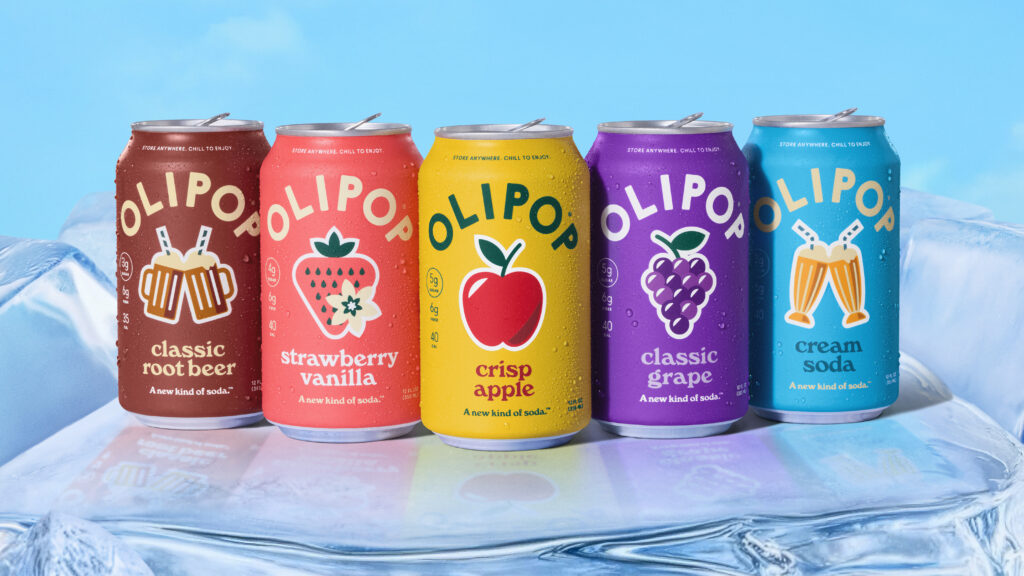
Piper joined OLIPOP as SVP of Marketing in mid-2025, stepping in just as the brand was crossing into its largest creative investment to date. “The feel good soda” launched this May as the brand’s first full platform overhaul: a new visual identity designed by Collins, a national CTV campaign airing across Disney, Hulu, Peacock, and Amazon, and the brand’s first sonic signature. All signal decisive action to exercise emotional ownership of a category that now has more competition than it has ever had.
The distinction Piper is managing runs deeper than a campaign. OLIPOP operates as two distinct products: a 9g fiber line stocked in the refrigerated section, and a 6g fiber shelf-stable line sitting alongside major legacy brands in the soda aisle. Keen marketing decision making to highlight the differentiation here is critical.
With that in mind and more, Aivanta caught up with Piper to talk about what changes when awareness of the category is no longer the challenge, how data and long-view brand bets coexist at OLIPOP, and what eight years of trust and research actually protect.

Your path to OLIPOP isn’t the obvious one. Feastables, BODYARMOR, and now a brand that essentially invented a category. How did you get here, and what drew you to this particular moment at OLIPOP?
The thread across all of it is actually pretty consistent, I’ve always been drawn to brands at inflection points. BODYARMOR was a scrappy challenger going up against Gatorade and the bet was that consumers would trade up for a better-for-you sports drink if you gave them a real reason to. Feastables was a case study in building a brand from an audience while also having a superior product. OLIPOP is a different kind of brand centered around redefining what a category means, not just capturing market share. What drew me to the brand was the opportunity to make an impact on consumer health at scale combined with the professional opportunity of getting to work with a brand that’s at an inflection point in its growth to reach that mass audience. OLIPOP recently reached a $1.85B valuation and we launched our first major brand platform “The feel good soda”. Building out this new platform combined with the brand’s infrastructure was really exciting to me.
You stepped into this role as OLIPOP was crossing into a new phase with scaled distribution, a unicorn valuation, and now a full brand platform launch. What’s surprised you most since you stepped in? What was different from what you expected?
The depth of the consumer relationship surprised me. I expected a passionate community because I’d seen the social media comments, I’d watched what the brand did with creators, but I underestimated how personally people connect with OLIPOP. There are customers who write in because they have family members dealing with digestive health issues or their parents who are grateful to have something their kids will actually drink that doesn’t have 40 grams of sugar. That level of emotional investment isn’t something you manufacture; it’s the result of years of our Co-Founder, Ben, and the team being relentlessly passionate about product quality and efficacy.
You helped build the category at the brands you came from, and now you’re running marketing for the brand that invented this one. How has that changed what you’re actually focused on?
At BODYARMOR, the job was awareness and trial to get people to understand that there was a better option. At OLIPOP, we’ve already won a version of that battle. The awareness question is different now; it’s not “do people know OLIPOP exists” but “do the people understand what it actually is and why it matters.” We want people who’ve been drinking traditional soda for 20 years or the parent standing in the Target soda aisle to understand that there’s a soda that can actually be part of a healthy life.
OLIPOP has a reputation for being deeply data-driven, using performance signals to make decisions about everything from SKU permanence to retail placement. How do you keep that rigor intact while also making the kinds of long-horizon brand bets the new “Feel Good Soda” platform represents?
You need both operating simultaneously, and you can’t let one crowd out the other. At OLIPOP, performance data is where we test and learn. Creative signals, organic engagement, retention curves, and new market velocity tell us whether something is connecting and how to optimize. Our new brand platform is where we’re making a longer bet about what kind of company OLIPOP is and what emotional role it plays in people’s lives. “The feel good soda” isn’t merely a tagline; it’s a frame for everything from our science story to the flavor experience, the cultural partnerships and the way we show up in the soda aisle. A national CTV campaign is evaluated on brand awareness lift, household penetration growth, and category conversion over a long-term window because it’s an investment in how our brand shows up consistently over time.
The new campaign is running nationally on CTV. For a brand that built its audience through organic content and creator partnerships, what drove the decision to go broad in that way, and how are you measuring whether it’s working?
The distribution really drove it because when you’re in over 65,000 retailers it’s important to create consistent national reach. CTV lets us reach people in the premium streaming environments they’re already paying attention to. “A Good Start” was also a very specific creative decision. The spot uses animation and a feel-good visual language to show the brand story of how one good choice can ripple outward through a day. We just launched less than a month ago but early reads are showing positive ad recall and positive brand awareness lift. And the creative itself reflects something we think about more broadly: when everyone can produce more content faster, the content that breaks through is content that feels unmistakably intentional. “A Good Start” has a visual sensibility and an emotional arc that requires real craft, and you can’t automate building something like that.
OLIPOP lives in two very different parts of the grocery store, being in both the health and wellness section and the soda aisle. Those aren’t the same shopper, or at least not the same moment. How do you think about that distinction in your marketing?
The wellness-section shopper is already in problem-solving mode. They’re reading labels, looking for something specific, fiber or low sugar. Our job there is to deliver clear, credible efficacy messaging and our higher fiber option, our 9g Fiber Line, is what people are looking for. The soda-aisle shopper is in a different headspace. They want something delicious, and we’ve found that the best outcome is when the soda-aisle shopper picks it up for taste and then discovers the functional benefits on the can and feels good about their choice. That’s why we created our shelf-stable line, our 6g Fiber Line, to give a lower fiber option for people that want to drink it more often as well. That’s what “The feel good soda” is really about, the feeling you get when a decision that tastes indulgent is actually better for you.
Every competitor coming into this space can match the functional story: the fiber, the prebiotics, the better-for-you positioning. “Feel Good” is a much more ephemeral thing to copy, but it’s also more difficult to protect. How do you think about holding that platform as the category continues to grow?
We welcome more brands leading with functionality, as long as it’s met with efficacy, because it validates the category we created and expands the pool of consumers interested in the functional category. What they can’t replicate is the eight years of trust we’ve built, the science rigor behind the formulation, and the community that came before the brand had any real marketing budget. “The feel good soda” is a platform built on a genuine product truth and consumer relationship. Our Co-Founder, Ben still formulates every flavor from his home lab, we have independent validation that what’s on the can is actually in the can and we continuously conduct research backing up the science.
What’s the advice you find yourself giving most often to marketing leaders who are earlier in their careers, or the thing you wish someone had said to you?
I always come back to staying curious. The marketing landscape is changing faster than ever, and the leaders who continue to learn, ask questions, test ideas and seek diverse perspectives consistently make better decisions. Curiosity leads to better consumer insights, stronger innovation and ultimately better business outcomes.